What creatives charge in 2027
A public-data study of freelance creative pricing, from day rates to project fees and usage rights.

By What Do I Charge? · 2027 edition · Version 1.0 · Evidence cutoff: 14 November 2026 · Published 14 November 2026
Creative work has more than one price. A designer may sell a day of work, an illustrator may license an image, and a photographer may quote a production that includes assistants, travel and equipment. Each figure answers a different question about what a creative charges.
This report brings those questions together. It catalogs 49 public source records and extracts 91 selected published statistics from 38 of them, with source links, dates, currencies and definitions. Those are counts of evidence records, not freelancers. The research is an original synthesis and analysis of other organizations’ data; it is not a new survey.
The year in the title identifies the edition. The observed prices were collected before 2027. Separately identified 2027 fee schedules had already been announced by the research cutoff. No observed 2027 market average or forecast is presented.
The findings worth citing
UK design and UX benchmarks increased in the same platform’s published series. YunoJuno’s mean UK design day rate rose from £367 in 2024 to £385 in 2025, a 4.9% nominal increase. Its UX discipline average rose from £425 to £452, or 6.4%. These figures combine approved contractor rates and confirmed bookings; they do not measure the same individuals’ pay rises. YunoJuno · D02 · YunoJuno · D03
The UK commercial-writing median increased 2.3%. ProCopywriters reported a median day rate of £440 in 2026, compared with £430 in 2025. Its 2025 mean was £480: comparing that mean with the 2026 median would create a false story of falling prices. ProCopywriters · W01
Day rates describe only a minority of illustrators’ primary pricing models in one recent survey. Of 342 Creative Boom respondents who answered the pricing-method question, 41 primarily used day rates: 12.0%, calculated for this report. The others selected project fees, mixed pricing or licensing. This is a readership-survey result, not an estimate for all illustrators. Creative Boom; Katy Cowan · V01
Time available for paid work changes the rate a business needs. With the same revenue target, 20% fewer billable hours requires a 25% higher effective hourly rate. This is an arithmetic relationship, not a prediction about demand. The worked example below makes the assumptions explicit.
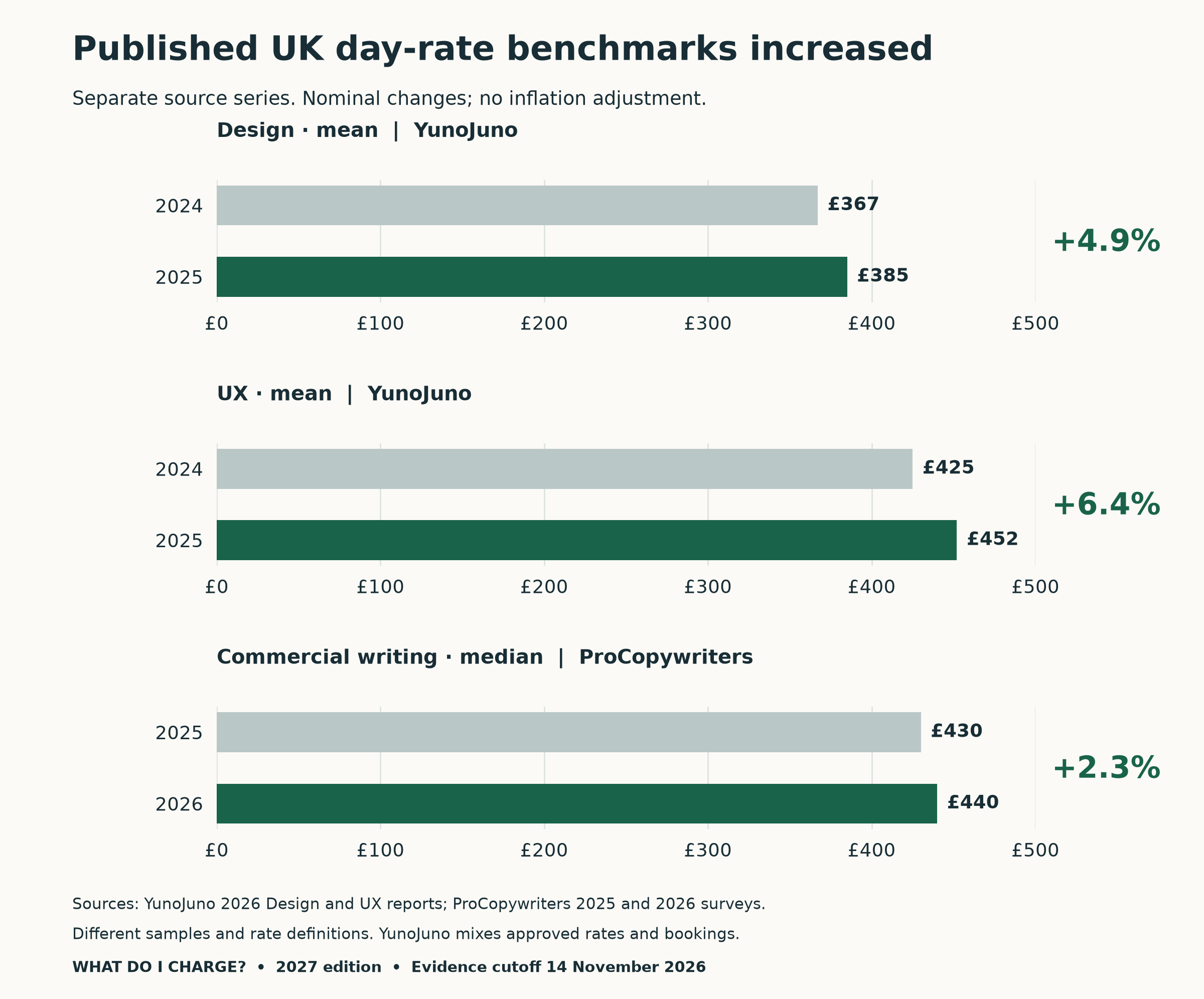
Figure 1. Changes in published UK day-rate benchmarks. The two YunoJuno comparisons cover 2024–2025; ProCopywriters covers 2025–2026 and uses a median. Separate samples, no inflation adjustment and no claim of statistical significance. Calculations C01–C03 in the downloadable data.
What the published rates actually measure
Mean is the arithmetic average. Median is the middle observation. A modal band is the most frequently selected bracket. An interquartile range contains the middle half of observations. A recommended minimum is guidance; an advertised starting price is an offer. None of these labels is interchangeable.
Currencies and billing units below are kept as published. A UK day rate and a US hourly rate are not converted versions of each other. Unless a source specifies a working-day length, this report makes no hourly conversion.
Design, UX and web work
UK graphic designer — £348/day. Mean; approved rates and bookings. 2025 role table · YunoJuno · D02
UK motion graphics designer — £385/day. Mean; approved rates and bookings. 2025 role table · YunoJuno · D02
UK product designer — £434/day. Mean; approved rates and bookings. 2025 role table · YunoJuno · D02
UK UX designer — £423/day. Role mean, distinct from the £452 UX discipline average. 2025 role table · YunoJuno · D03
Freelance designers, global survey with US-led recruitment — US$100–149/hour; US$500–699/day. Most common hourly and daily bands. 2026 · Fast Company with AIGA; Empire Insights · D10
Web designers, predominantly US community — US$92.75/hour. Median among hourly chargers; publisher converted non-USD answers. 2025 · Web Designer Academy · D11
Netherlands designers — €72/hour. Mean self-reported charge, excluding VAT. 2026 · Knab · G06
DACH-focused design, media and creative respondents — €89/hour. Mean self-reported hourly rate. 2026 · freelancermap · G01
France, experienced graphic designers — €402/day. Mean advertised rate on active profiles. Snapshot accessed November 2026 · Malt · D05
The AIGA/Fast Company/Empire Insights study surveyed 1,273 freelance designers and 153 hiring companies in early 2026. Its most common hourly band is useful evidence, but it is not the median of all designers. Recruitment was voluntary and 57% of the designer sample had at least 15 years’ experience. A student should not read that band as an entry-level guarantee. Fast Company with AIGA; Empire Insights · D10
The European figures also describe different populations. Knab surveys self-employed people in the Netherlands; freelancermap’s creative respondents form a small subgroup of a DACH-focused platform survey. Malt measures profile rates. Their differences cannot establish which country pays creatives best. Knab · G06 · freelancermap · G01 · Malt · D05
Finland’s Ornamo report shows why a single number can obscure the distribution: 19% of surveyed design businesses billed below €50/hour. Another 19% billed at least €100/hour, calculated by adding the published 16% and 3% upper bands. These businesses include larger firms as well as freelancers. The rate-question sample size is not disclosed. Ornamo · G02
Writing, editing and documentation
UK freelance commercial writing — £440/day. Median self-reported charge. February 2026 survey · ProCopywriters · W01
Netherlands copywriting — €78/hour. Mean self-reported charge, excluding VAT. 2026 · Knab · G07
EFA business/marketing copyediting — US$50–60/hour. Publisher’s “median-rate range”. 2025 work, published 2026 · Editorial Freelancers Association · W02
EFA business/marketing proofreading — US$45–60/hour. Publisher’s “median-rate range”. 2025 work, published 2026 · Editorial Freelancers Association · W02
EFA blog writing, work for hire — US$74.50–87.50/hour. Publisher’s “median-rate range”. 2025 work, published 2026 · Editorial Freelancers Association · W02
EFA medical writing, work for hire — US$90–113/hour. Publisher’s “median-rate range”. 2025 work, published 2026 · Editorial Freelancers Association · W02
Southern Africa, general nonfiction writing — R400–500/hour. Most common reported band. 2025/early 2026 survey · Safrea · W05
Southern Africa, technical/specialist writing — R600–900/hour. Most common reported band. 2025/early 2026 survey · Safrea · W05
Documentation contractors, worldwide — US$58/hour. Median; middle half US$44–84; n=67. 2025; source-converted currencies · Write the Docs · W11
Reedsy book copyediting — US$27 per 1,000 words. Marketplace average; page reports 9,000+ projects. Observation window undisclosed · Reedsy · W04
The Editorial Freelancers Association survey had more than 1,100 participants, but that is not the sample size for every service. Its ranges are labeled as the publisher labels them; the accessible methodology does not establish a percentile interpretation for their endpoints. The EFA does not set or recommend these rates. Editorial Freelancers Association · W02
Reedsy is useful for a different buying decision: editing a manuscript. The same published values appeared in earlier guidance, so a page carrying “2026” is insufficient evidence that the underlying projects took place in 2026. Word-based prices also require agreement on manuscript length, editing depth and revision scope. Reedsy · W04
Illustration, photography, animation and sound
UK illustration day rates — £280–450/day. Middle half of 90 usable UK responses. July 2026 · Creative Boom; Katy Cowan · V01
UK freelance animation/VFX, 1–3 years’ experience — £230/day. Median, n=12; publisher adjusted survey rates for inflation. 2024–25 collection, January 2025 basis · Bectu Animation & VFX Union · V02
UK freelance animation/VFX, 10+ years’ experience — £360/day. Median, n=47; same adjustment. 2024–25 collection, January 2025 basis · Bectu Animation & VFX Union · V02
Netherlands photography — €94/hour. Mean self-reported charge, excluding VAT. 2026 · Knab · G08
France, experienced photographers — €523/day. Mean advertised rate on active profiles. Snapshot accessed November 2026 · Malt · D06
The animation/VFX day means up to eight working hours plus an unpaid lunch hour. Equipment and software costs are additional. Other sources do not necessarily define a day the same way. Bectu Animation & VFX Union · V02
For illustration, a license can change the commercial value of the same artwork without changing the hours needed to make it. Creative Boom’s pricing-method counts were 174 primarily using project fees, 96 mixed pricing, 41 day rates and 31 primarily licensing. The article inconsistently labels its central day-rate statistic as an average and a median; this report therefore uses its explicitly identified middle-half interval. Creative Boom; Katy Cowan · V01
What clients pay for projects and packages
Project figures need a scope beside the price. The following evidence is useful for understanding how services are sold, but the rows do not represent equivalent deliverables.
Web design, predominantly US community — US$2,500–4,999/project. Most common typical-project band; 82% primarily used package pricing. 2025 · Web Designer Academy · D11
Poland-facing platform, graphic design — PLN 2,004/assignment. Mean amount for settled 2025 work; deliverable scope varies. Useme · G05
Poland-facing platform, UX/UI — PLN 3,656/assignment. Same platform; no standardized project size. Useme · G05
Poland-facing platform, copywriting — PLN 1,576/assignment. Same platform; length and scope vary. Useme · G05
India, logo design — ₹5,400/project. Median advertised starting package, n=35; specified taxes/fees included, extra platform fee excluded. October 2026 snapshot · Foxpop · G09
India, full-day photography, up to nine hours — ₹14,400/day. Median advertised starting package, n=151; same fee treatment. October 2026 snapshot · Foxpop · G09
India, edited reel/short video — ₹1,800/reel. Median advertised starting package, n=72; same fee treatment. October 2026 snapshot · Foxpop · G09
India, full social-media management — ₹30,000/month. Median advertised starting package, n=67; deliverables must be checked. October 2026 snapshot · Foxpop · G09
US wedding photography — US$3,000/wedding. Average buyer-reported vendor spend; package, not an individual’s wage. Weddings in 2025 · The Knot: photography
US wedding videography — US$2,300/wedding. Average buyer-reported vendor spend. Weddings in 2025 · The Knot: videography
US live wedding band — US$4,500/booking. Whole-band average, not pay per musician. Weddings in 2025 · The Knot: band and DJ
Useme’s figures are based on work settled through its platform. Foxpop’s India figures describe advertised starting packages and include 18% GST plus a 2% convenience fee, while excluding an additional platform fee. One is a record of settled assignments; the other is a price available to browse. Neither supplies a universal quote for the named service. Useme · G05 · Foxpop · G09
An accepted commercial-photography estimate shows another reason to separate the parts of a price. Wonderful Machine’s published case for a seven-day cruise assignment totaled US$59,921, made up of US$41,500 in fees and US$18,421 in expenses, with perpetual advertising rights. It is one accepted proposal, not a market average or proof of payment. Treating the entire amount as a photographer’s personal earnings would misstate the transaction. Wonderful Machine; Marianne Lee; published on A Photo Editor · V03
What is already published for 2027
Some 2027 figures are known because an organization has published a fee schedule in advance. These belong in a separate category from observed market prices.
PACT/Musicians’ Union agreement, 2027 column — £254.53. Basic minimum three-hour recording session; use, rights and overtime conditions apply. Musicians’ Union and PACT · V07
CARFAC–RAAV 2027 exhibition royalties — C$2,677. Solo exhibition up to three months at a publicly funded Canadian Category I presenter with an operating budget below C$500,000; other costs separate. CARFAC–RAAV · V09
CARFAC–RAAV 2027 professional services — C$787/day. Solo presentation lasting more than four hours. CARFAC–RAAV · V10
CARFAC–RAAV specifies using the schedule for the year the exhibition or service takes place. Its figures are recommended minimums. The PACT/MU figure is an agreement minimum within that agreement’s scope; this report uses its published year label without inferring an unstated transition date. CARFAC–RAAV · V09 · CARFAC–RAAV · V10 · Musicians’ Union and PACT · V07
Other useful guidance spans part of the planning period:
CIEP 2026–27 — £31.92/hour proofreading; £37.11/hour copyediting. Suggested minimums effective 1 March 2026; may change in March 2027. CIEP · W03
Australian Society of Authors 2026/27 — A$778 full-page color illustration; A$1,495 color cover. Recommended book-illustration minimums, not observed sales. Australian Society of Authors · V04
Bectu post-sound 2025–26 — £455/day factual/entertainment mixer; £635 including studio. Recommended minimums; eight working hours plus lunch; availability does not establish 2027 validity. Bectu Post Production & Facilities Branch · V05
Scottish Artists Union 2026–27 — £248/day entry level; £366.40/day with 5+ years’ experience. Recommended eight-hour-day rates. Scottish Artists Union · V11
These schedules help specify a contract. They should not be presented as evidence that every practitioner actually receives the listed amount, or as a legal minimum outside an applicable agreement.
The rate a creative needs depends on paid time
A market benchmark describes other people’s prices. A business floor starts with the revenue your own work needs to generate. The denominator is the time you can realistically bill and collect, after allowing for administration, pitching, revisions that were not priced, professional development and time off.
Consider a hypothetical freelancer targeting US$100,000 in annual business revenue, working 46 weeks at 35 hours per week. Revenue here is before business expenses and personal taxes; it is not take-home pay. Assume every billable hour is collected at the stated effective rate.
40% billable — 644 billable hours a year — US$155.28/hour required
50% billable — 805 billable hours a year — US$124.22/hour required
60% billable — 966 billable hours a year — US$103.52/hour required
70% billable — 1,127 billable hours a year — US$88.73/hour required
80% billable — 1,288 billable hours a year — US$77.64/hour required
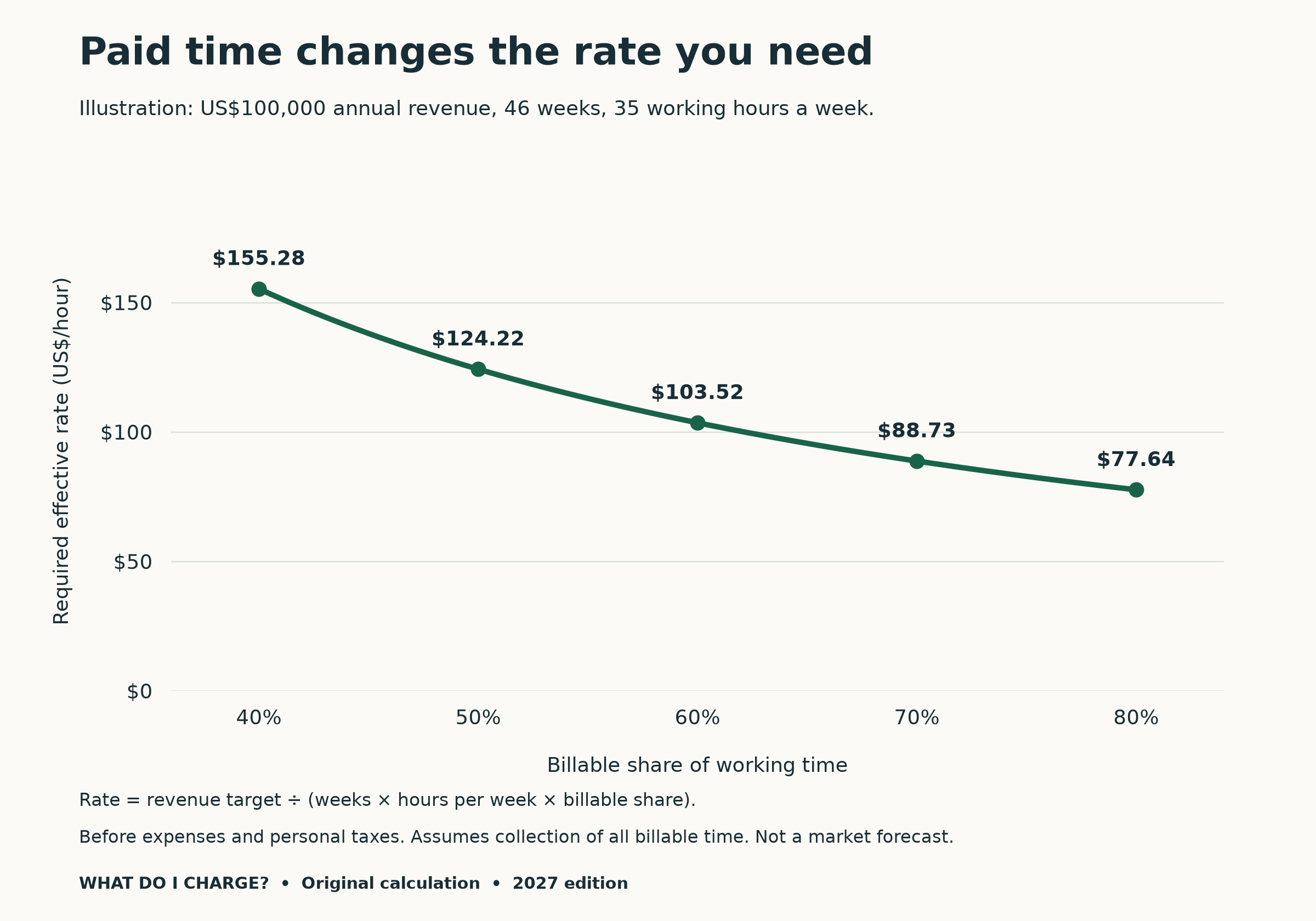
Figure 2. An illustrative revenue calculation, not surveyed prices or a forecast. Formula: required hourly rate = annual revenue target ÷ (working weeks × hours per week × billable share). Values are rounded to the nearest cent. Calculations C09–C13.
Moving from 60% to 50% billable time requires a 20% rate increase to preserve revenue. More generally, losing 20% of paid hours requires a 25% increase in the effective rate. A 10% price rise combined with 20% fewer paid hours would instead leave revenue 12% lower. All three statements hold the other assumptions constant.
For fixed-fee work, calculate the effective rate after the project: collected service revenue divided by all delivery hours, including unbilled revisions. Track pass-through expenses separately. This makes a project quote comparable with your own capacity, while leaving licensing and usage value visible in the contract.
Use the free What Do I Charge? calculator to work through your income goal, costs, working schedule and billable share. Then compare the result with evidence for the relevant service, client and market. A quote should specify deliverables, revisions, usage, time, expenses and payment terms; the market table cannot fill those in for you.
What journalists and design schools should take from the data
The useful question is not simply “What is the going rate?” It is “For which service, in which market, under which terms, measured how and when?”
When reporting a figure, carry its definition with it. “The median in a voluntary UK copywriter survey was £440 per day” is a supported statement. “Creatives earn £440 a day” is not. Likewise, a popular price band does not establish a minimum, and an exhibition royalty does not pay for every hour or expense involved in creating the work.
For a classroom exercise, ask students to price the same brief as an hourly engagement, a fixed project and a license. Have them state the revision allowance and the permitted uses, then calculate the effective hourly rate at two different delivery times. The lesson is to connect scope and sustainability to the price, rather than memorize a single industry average.
Historical figures that should not be relabeled as 2027
Payoneer Freelancer Insights · G04. 2023 report: mean US$22/hour web/graphic design, US$26 content writing, US$35 multimedia. Older international respondent sample; no 2027 observation.
ITI/Inbox Translation · W06. 2023 data: median £0.075/source word for general agency work; £0.10 for direct clients. Membership sample and different client populations.
ATA compensation survey, sixth edition · W08. 2019 data; selected Spanish-to-English median US$0.13/source word. A 2025 file path does not make it 2025 data.
Peak Freelance · W09. November 2021 survey, despite a 2026 page title. Search titles and update dates can obscure fieldwork age.
Annual salary statistics are another category entirely: the US Bureau of Labor Statistics explicitly excludes self-employed workers from the occupational wage figures discussed on its graphic-design page. A salary divided by working hours does not become a freelance selling price. US Bureau of Labor Statistics · G11
Methodology and limitations
How sources were selected
We searched for primary evidence across design, writing, editing, illustration, photography, motion and related creative services. We preferred the original report, rate table or publisher’s explanation over articles repeating another organization’s figures.
Sources were eligible for a benchmark when the public material identified the service, amount, currency and pricing unit sufficiently clearly to interpret the result. Where available, we recorded fieldwork or transaction dates, publication date, location, sample size, recruitment method, statistical measure and service scope. Older studies were retained as historical context where useful. Recent page updates were not treated as proof of recent fieldwork.
This is a structured evidence review, not an exhaustive census of every public price or a registered systematic review. Search visibility, language, access and the information publishers release limit its coverage. Some relevant reports provide only a public summary; inaccessible detail was not inferred. Unverified anecdotes and compilations without a traceable primary source were excluded from the main comparisons.
What the figures measure
Every rate must be read with its evidence type. A settled transaction, an approved contractor rate, a freelancer’s survey response, an advertised price and a suggested fee describe different things. Mixed datasets retain that qualification. Recommended minima and future schedules are kept separate from observed or reported prices.
We also preserve the source’s statistic. A mean is an arithmetic average; a median is the midpoint; a modal band is the most frequently selected price interval. Published ranges are not automatically minimum–maximum spans, interquartile ranges or confidence intervals. When a publisher’s definition is incomplete or inconsistent, the report says so rather than assigning a stronger interpretation.
Hourly, daily, per-word and project fees remain in their original units and currencies. We do not assume a standard working day, convert a project into an hourly rate, or combine prices into one worldwide average. Billing rates are not take-home pay: unpaid administration, expenses, taxes, commissions, rights and subcontractors can affect what remains.
Calculations and comparisons
Any percentage change calculated by whatdoicharge.work uses the stated earlier value as the denominator: later value divided by earlier value, minus one. Comparisons use the same named statistic and source series wherever possible.
A difference between two annual surveys is a difference between their samples. It does not show that the same individuals raised their prices, and it can reflect changes in respondents, roles or clients. No headline rate is extrapolated into a forecast for 2027.
Limits of the evidence
Most samples are voluntary or drawn from a particular association, platform or professional community. They may overrepresent experienced practitioners, certain regions or people willing to discuss money. Many publishers disclose a total sample without the number answering a particular rate question. A large headline sample cannot establish the reliability of every category.
Respondents may appear in multiple sources. Platform datapoints may also include several records for one person, and translation surveys may record multiple language pairs. We therefore do not add sample counts together or describe them as a single survey of creatives.
Project scopes differ substantially. Usage rights, revisions, turnaround, equipment, production expenses and client type can change a quote. A case study illustrates a transaction or estimate, not a typical market price. These benchmarks support comparison and further reporting; they cannot determine the correct fee for an individual commission.
The review is English-led, with selected French, German, Dutch, Polish and Finnish publications. Coverage is strongest in the US, UK and Europe, with selected evidence from Southern Africa, India, Australia and Canada. Latin America, East Asia and the Middle East are not comprehensively covered. No causal claim about AI or demographic pay differences is made from this evidence. The downloadable codebook documents inclusion decisions and source-specific ambiguities.
The CSV files contain selected factual extracts and source notes, not original survey microdata. The same data is also available as JSON: observations · source register · calculations. The data codebook defines every field and documents inclusion decisions.
How to cite this report
Suggested citation: What Do I Charge? (2026). What creatives charge in 2027. 2027 edition, version 1.0. Evidence cutoff 14 November 2026. https://whatdoicharge.work/what-creatives-charge-2027. Add your access date.
For a source’s original statistic, name that source as well as this synthesis. For a calculation introduced here, cite What Do I Charge? and the underlying inputs. For example: “What Do I Charge?’s analysis of YunoJuno’s published UK design averages found a 4.9% nominal increase between 2024 and 2025.”
Chart credit: What Do I Charge?; underlying sources identified in the figure notes. Retain the date, units and methodological notes when reproducing a chart. The source organizations retain rights in their own publications; this package contains selected factual extracts and original analysis, not copies of their full reports.
Commercial context: What Do I Charge? publishes this report alongside its freelance-pricing calculator. The report does not use private calculator submissions, commissioned survey responses or affiliate rankings. No source was contacted to verify or endorse the interpretation.
Corrections and versions: This is version 1.0. Any later edition should preserve the original data file, identify changed observations by ID, and distinguish corrected transcription from newly available evidence. The dated cutoff makes the evidence base reproducible without implying that a live source page will remain unchanged.
Source register
The full register includes sources used for numeric benchmarks, professional guidance, historical context and items reviewed without extracting a rate. Related pages can belong to the same study. Source records and sample sizes must not be added together as independent respondents.
D01 · YunoJuno — The 2026 Contractor and Freelancer Rates Report. Period: 2024–2025. Population: 182,000+ mixed data points; not people or contracts. Methodological source for related records.
D02 · YunoJuno — Design Contractor Rates 2026. Period: 2024–2025. Population: Same overall dataset as D01; design cell undisclosed. Selected facts extracted; read observation status and caveats.
D03 · YunoJuno — UX Contractor Rates 2026. Period: 2024–2025. Population: Same overall dataset as D01; UX cell undisclosed. Selected facts extracted; read observation status and caveats.
D04 · Represent — 2026 Salary Survey. Period: 2026 guide. Population: Not disclosed. Context only; recruiter ranges lack disclosed sampling method.
D05 · Malt — Grille des tarifs 2026: Les Graphistes freelances. Period: Profiles active during previous three months. Population: Profile inventory shown; analytic denominator undisclosed. Selected facts extracted; read observation status and caveats.
D06 · Malt — Grille des tarifs 2026: Motions designers et réalisateurs. Period: Profiles active during previous three months. Population: Category denominators undisclosed. Selected facts extracted; read observation status and caveats.
D07 · Major Players — Creative Industries Census 2026. Period: Exact fieldwork period unstated. Population: 4,024 professionals; 266 brands/agencies; 393,690 reported data points. Context only; headline growth definition insufficient for selected calculations.
D08 · Second Wind — 2024 Annual Agency Survey Report. Period: 2024 rates; 2023 financials. Population: 102 responding member agencies. Historical catalog; freelance-table hourly unit is inferred.
D09 · Design Business Association / Moore Kingston Smith — 2023 DBA Annual Survey Report. Period: Fieldwork 2023-05-01 to 2023-06-16. Population: 142 member design agencies. Historical agency survey; current comparable detail unavailable.
D10 · Fast Company with AIGA; research support Empire Insights — 2026 Freelance Design Pricing Transparency Study. Period: 2026-02-25 to 2026-04-12. Population: 1,273 freelance respondents; 153 hiring companies; rate-question counts unknown. Selected facts extracted; read observation status and caveats.
D11 · Web Designer Academy / Shannon Mattern — State of Web Designer Pricing 2025. Period: 2025-03-02 to 2025-04-04. Population: 208 community respondents; hourly subset undisclosed. Selected facts extracted; read observation status and caveats.
W01 · ProCopywriters — Copywriter Survey 2026. Period: 2026-02. Population: 573 writers; pricing guide identifies 383 freelancers. Selected facts extracted; read observation status and caveats.
W02 · Editorial Freelancers Association — 2026 Editorial Rate Chart. Period: 2025 work; fieldwork November 2025–January 2026. Population: More than 1,100 respondents; rate-cell counts undisclosed. Selected facts extracted; read observation status and caveats.
W03 · Chartered Institute of Editing and Proofreading — Suggested minimum rates 2026–27. Period: 2026–2027 guidance. Population: Not applicable. Selected facts extracted; read observation status and caveats.
W04 · Reedsy — Book editing services: marketplace average rates. Period: Unspecified historical marketplace period. Population: 9,000+ developmental, 9,000+ copyediting and 5,000 proofreading projects; possible overlap. Selected facts extracted; read observation status and caveats.
W05 · Safrea — Southern African Freelance Rates Survey Report 2026. Period: 2025 and early 2026 collection. Population: 413 respondents; category counts unstated. Selected facts extracted; read observation status and caveats.
W06 · Institute of Translation and Interpreting; survey with Inbox Translation — Freelance Translator Rates: The Value of ITI Membership. Period: 2023-02-14 to 2023-03-13. Population: 692 ITI respondents; 23.3% response; rate cells count language pairs. Selected facts extracted; read observation status and caveats.
W07 · Authors Guild — Survey of U.S. Literary Translators’ Working Conditions in 2022. Period: October 2022; most recent book contract. Population: 279 respondents; prose rate subset unspecified. Selected facts extracted; read observation status and caveats.
W08 · American Translators Association — ATA Compensation Survey, Sixth Edition. Period: 2019 compensation. Population: 739 eligible; selected Spanish–English cell 48. Selected facts extracted; read observation status and caveats.
W09 · Peak Freelance — Freelance Writing Rates: How Much to Charge as a Freelance Writer (2026). Period: Body references 2021 experience and 2020 income. Population: 213 part-time/full-time writers. Selected facts extracted; read observation status and caveats.
W10 · New Zealand Society of Translators & Interpreters — National Survey of Translator & Interpreter Rates & Working Conditions: Summary. Period: July–September 2024. Population: 362 total; 171 translators; 249 rate/practice replies. Public summary does not disclose detailed rates.
W11 · Write the Docs — Documentation Salary Survey: 2025 Results. Period: 2025. Population: 755 respondents; 80 contract-rate sets; 67 hourly worldwide, 47 North America. Selected facts extracted; read observation status and caveats.
W12 · ELIS Research and partner associations — European Language Industry Survey 2026. Period: 2025 performance; 2026 expectations. Population: 564 independents; headline 1,058 across segments. Industry context; no fee extracted.
V01 · Creative Boom; Katy Cowan — Illustrator pricing in 2026: what 403 artists told us about day rates, licensing & the 20% who feel fairly paid. Period: July 2026. Population: 403 total; 146 UK; 90 usable UK rates; 342 pricing-method responses. Selected facts extracted; read observation status and caveats.
V02 · Bectu Animation & VFX Union — Animation & Visual Effects Union UK Rate Card 2025. Period: 2024-11-13 to 2025-01-12; adjusted to January 2025. Population: 100 freelancers; experience cells 12/24/17/47; 325 PAYE separately. Selected facts extracted; read observation status and caveats.
V03 · Wonderful Machine; Marianne Lee; published on A Photo Editor — Pricing & Negotiating: What A $50k Handshake Was Actually Worth. Period: Recent 2026 proposal; prior-year comparison. Population: One case. Selected facts extracted; read observation status and caveats.
V04 · Australian Society of Authors — Rates of Pay: Book Illustration. Period: 2026–2027 financial year. Population: No statistical sample stated. Selected facts extracted; read observation status and caveats.
V05 · Bectu Post Production & Facilities Branch — Post-Sound Rate Card 2025–2026. Period: 2025–2026 guidance. Population: Undisclosed. Selected facts extracted; read observation status and caveats.
V06 · Bectu Post Production & Facilities Branch — Short Form Rate Card 2023–2024 (listed as 2023–2025). Period: 2023–2024 guidance. Population: Undisclosed. Historical card with inconsistent date labels; no current rate extracted.
V07 · Musicians’ Union and PACT — PACT/Musicians’ Union Agreement for Engagement of Session Musicians 2026–2028. Period: Scheduled 2026–2028 agreement. Population: Not applicable. Selected facts extracted; read observation status and caveats.
V08 · National Association for the Visual Arts — NAVA Code of Practice: Workshops. Period: 2026 guidance. Population: Not applicable. Selected facts extracted; read observation status and caveats.
V09 · CARFAC–RAAV — 2027 Exhibition and Screening Royalty Schedule. Period: Scheduled 2027 recommendations. Population: Not applicable. Selected facts extracted; read observation status and caveats.
V10 · CARFAC–RAAV — 2027 Artist Professional Services Fee Schedule. Period: Scheduled 2027 recommendations. Population: Not applicable. Selected facts extracted; read observation status and caveats.
V11 · Scottish Artists Union — Recommended Rates of Pay 2026–2027. Period: Effective April 2026. Population: Not applicable. Selected facts extracted; read observation status and caveats.
V12 · CREATe, University of Glasgow; commissioned by DACS — UK Visual Artists 2024: A survey of earnings and contracts. Period: 2022–2023 earnings; February–April 2024 fieldwork. Population: 1,241 respondents; 8.9% response; 781 primary-occupation earnings subset. Selected facts extracted; read observation status and caveats.
V13 · Zenfolio/ShootProof and research partners — 2026 State of the Photography Industry. Period: Early 2026; 2025 experience. Population: 4,916 respondents; item denominators undisclosed. Selected facts extracted; read observation status and caveats.
V14 · The Knot Research & Insights Team; The Knot Worldwide — The Knot Real Weddings Study 2026: selected vendor costs. Period: 2025 weddings. Population: 10,474 couples; vendor-specific counts undisclosed. Selected facts extracted; read observation status and caveats.
G01 · freelancermap — Freelancer-Kompass 2026. Period: Income survey 2026-01-19 to 2026-02-08. Population: 1,310 income respondents; 5,412 participations across four surveys; creative cell unknown. Selected facts extracted; read observation status and caveats.
G02 · Ornamo / Pekka Lith — Design Pulssi 2026. Period: Early 2026. Population: 544 respondents, including 102 firms/freelancers; billing-cell count unknown. Selected facts extracted; read observation status and caveats.
G03 · Freelancers in Belgium — Freelancing in Belgium: Trends & Insights 2025. Period: April 2025. Population: 316 respondents; 290 active; small creative cells. Small creative cell; narrative cluster is not a defined interval.
G04 · Payoneer — 2023 Freelancer Insights Report. Period: Fieldwork dates unstated. Population: More than 2,000 respondents; role counts unstated. Selected facts extracted; read observation status and caveats.
G05 · Useme — Ile zapłacić freelancerowi w 2026? Stawki freelancerów. Period: 2025 settled contracts. Population: Contract count undisclosed. Selected facts extracted; read observation status and caveats.
G06 · Knab — Uurtarief designer zzp in 2026. Period: 2026 rates; 2025 outcomes. Population: 20,000+ across occupations; designer cell undisclosed. Selected facts extracted; read observation status and caveats.
G07 · Knab — Uurtarief copywriter zzp in 2026. Period: 2026 rates; 2025 outcomes. Population: 20,000+ across occupations; copywriter cell undisclosed. Selected facts extracted; read observation status and caveats.
G08 · Knab — Uurtarief fotograaf zzp in 2026. Period: 2026 rates; 2025 outcomes. Population: 20,000+ across occupations; photographer cell undisclosed. Selected facts extracted; read observation status and caveats.
G09 · Foxpop — Creative rates in India, October to December 2026. Period: Snapshot 26 October 2026. Population: 420 active verified profiles; at least five listings per selected package. Selected facts extracted; read observation status and caveats.
G10 · SuperStuff — Pay & Pricing Benchmark 2026–27. Period: Through 2026; exact period unstated. Population: 5,600+ freelancers; category counts undisclosed. Selected facts extracted; read observation status and caveats.
G11 · US Bureau of Labor Statistics — Graphic Designers: Occupational Outlook Handbook. Period: May 2025 wages. Population: Official OEWS employee sample. Employee-wage context; not freelance selling prices.
G12 · Upwork — Graphic Designer Hourly Rates. Period: Unspecified historical period. Population: Undisclosed. Public search result found; direct page not accessible for verification.
Notes for journalists
Research type: original synthesis and secondary analysis of public evidence. No new survey was conducted. This edition catalogs 49 source records and extracts 91 selected statistics from 38 of those records. These are evidence-record counts, not a combined participant sample. Several records belong to the same underlying study.
Four supported reporting angles
1. UK rate benchmarks increased, with different periods and measures. Suggested wording: “What Do I Charge?’s analysis of YunoJuno’s published UK averages found that design day rates increased 4.9% between 2024 and 2025, while UX increased 6.4%. The platform combines approved contractor rates and confirmed bookings.”
Inputs: design £367 to £385; UX £425 to £452. Calculations C01–C02. These are nominal changes in aggregate benchmarks, not same-person pay rises or inflation-adjusted gains. Sources: YunoJuno design, YunoJuno UX, methodology.
2. A median-versus-mean comparison can invent a fall in writing rates. Suggested wording: “The median in ProCopywriters’ UK survey rose from £430 per day in 2025 to £440 in 2026, a 2.3% nominal increase calculated by What Do I Charge?. Comparing the 2026 median with the £480 mean reported for 2025 would compare different statistics.”
Calculation C03. Separate annual survey samples. Sources: 2025 survey, 2026 survey.
3. Day-rate tables miss much of how illustrators price. Suggested wording: “Only 12.0% of the 342 illustrators who answered Creative Boom’s pricing-method question said they primarily used day rates, according to What Do I Charge?’s calculation from the published counts.”
Calculation C04: 41 ÷ 342 × 100. The other answers were project fees, mixed pricing and licensing. This voluntary readership sample is not representative of all illustrators. The denominator is not the separate 90-person UK day-rate subset. Source: Creative Boom’s survey.
4. A higher rate does not necessarily mean higher revenue. Suggested wording: “A freelancer who loses 20% of billable hours needs a 25% increase in the effective hourly rate to preserve revenue, holding other assumptions constant. A 10% price rise alongside 20% fewer paid hours leaves revenue 12% lower.”
Calculations C06 and C08. This is arithmetic illustrated by the report, not a survey finding or prediction of working hours. It does not account for changed expenses or tax.
Attribution and context to retain
Name the original producer for a published statistic; name What Do I Charge? for this synthesis or its stated calculations.
Preserve the source period, geography, currency, billing unit and statistic. Do not relabel observations as 2027 prices.
A mean, median, popular price band, advertised rate, settled transaction and recommended minimum describe different evidence.
Do not turn a project budget into personal earnings, treat a recommendation as a universal legal minimum, or combine sample sizes into a single total.
Keep the source notes with chart reproductions. Original source reports are linked, not relicensed by this report.
This report was prepared for the site’s own publication. It does not imply peer review, endorsement by a source organization, or guaranteed media coverage.
Corrections and press inquiries
Spotted an error, or want to ask about the research? Get in touch through the contact page. Corrections are recorded with the observation ID, original value, revised value, reason and date, and affected charts and text are updated together.